Showing posts with label boomers. Show all posts

Wednesday, February 20, 2008

Resources for Intergenerational Programs

While looking through the resources in the Creating Aging Friendly Communities conference, I came across a reference to United Generations Ontario. This non-profit organization is "... dedicated to promoting the effectiveness and efficiency of other registered Canadian charities involved in providing benefits to members of different generations - children, youth, their parents and people of their parents' generation, seniors and other older adults." They provide a free pdf called Connecting Generations Toolkit: Best Practices in Intergenerational Programing.

This toolkit lists the benefits of intergenerational programs, such as:

  • emotional support
  • social role development
  • mental stimulation
  • understanding the needs of other generations

This toolkit also provides tips and recommendations about how to successfully create partnerships with other organizations to provide intergenerational programming. There is also a database of resources. However, the links to many of the websites and pdf files are not working through their search page. Here are some useful resources that I did find through the site:

Intergenerational Programs and Aging - with great program examples, resource links, and research about intergenerational programs (from Penn State University College of Agriculture Sciences).

Strengthening Families and Communities by Sharing Life Stories

Bridging the Gap

Tried and True: A Guide to Successful Intergenerational Activities at Shared Site Programs

AddThis Social Bookmark Button

Tuesday, December 04, 2007

New Research on Baby Boomer Volunteers

The Corporation for National and Community Service is a government agency that supports volunteer organizations, conducts research about volunteerism, and promotes volunteering in the United States. They have recently published an issue brief called "Baby Boomers and Volunteering: Findings from Corporation Research" and a research report called "Keeping Baby Boomers Volunteering: a Research Brief on Retention and Turnover" (found via theMatureMarket.com).

Key Findings of These Reports:

  • Baby Boomers from 46-57 have higher volunteer rates than older generations.
  • How Baby Boomers become volunteers is important - people asked to help by the volunteer organization have a much higher retention rate than those asked by their employer to volunteer.
  • Baby Boomers favorite type of volunteering is with religious organizations.
  • Baby Boomers' second favorite type of volunteer activity is educational and youth services - whereas previous generations chose civic, political, business and international volunteer work as their second most popular volunteer category.
  • Remaining in the workforce increases the likelihood that a Baby Boomer will stay in their volunteer position.
  • A higher educational level and a tendency to have children later in life seem to be factors in the high volunteer rate of Baby Boomers.
  • Baby Boomers volunteers who do management or professional tasks, rather than general labor, are more likely to continue to volunteer.
The Corporation for National and Community Service has projected the number of volunteers from 2007 to 2050. They created this projection by multiplying the estimated probability of volunteering by the number of people age 65 and older for each year. There are a little under 9 million senior volunteers at present. They predict that there will be 9 and a half million senior volunteers by 2010 and over 13 million in 2020. That is approximately a 44% increase in the next 13 years!

These statistics have great implications for public libraries. First, here is a great opportunity for libraries to gain more older adult volunteers in the future. Currently, many older adult volunteers help libraries by doing tasks such as pulling hold requests and shelving books. This research shows that many Boomers will want to be challenged and use their life skills in their volunteer work. Therefore, we should consider how to recruit older adults to give programs, to lead workshops at the library, or to become mentors at our libraries.

Related research report from Dec 2006:
Volunteer Growth in America: A Review of Trends since 1974

See also these previous posts:
How Volunteering Can Benefit Older Adults
Age Differences in Volunteering

AddThis Social Bookmark Button

Thursday, November 15, 2007

Aging in Place

Partners for Livable Communities has partnered with many organizations including the National Association for Area Agencies on Aging (n4a) and AARP to “develop a "Blueprint for Change" that will imagine what an elder-friendly community might be: what it would look like, what services it needs, how older persons can be involved in the planning, what special educational, recreational and cultural opportunities are needed, how cross-generational contacts can be made, and what programs are helping older persons feel safe and secure.” This partnership has created many resources for communities and older adults concerning “aging in place”.

NeighborWorks America is hosting these resources. The web pages about “aging in place” include: articles, links to organizations, and reports and studies.

I found one of the studies particularly interesting - “Livable Communities & Aging in Place” by Elli Dalrymple. This report states that “Aging in place is more than the ability to remain in one’s home; it is also the ability to continue to function and thrive in one’s community.” There are many issues related to “aging in place”. Besides affordable housing and transportation, there is also a need for older adult recreational, educational, social, and cultural opportunities.

Libraries can play a key part in responding to these older adult needs. There are several ways that libraries can contribute to the quality of life of older adults in our communities. Libraries can provide educational opportunities through our computer classes, genealogy classes, gardening classes, etc. Libraries can be very helpful in increasing social opportunities through our programming and through providing meeting space for clubs. Also, libraries can be a place for older adults to volunteer in their community and to find information about other local volunteer opportunities.

Finally, libraries can provide cultural programming. As Mr. Dalrymple stated,
“… there will be a great need to highlight the uniqueness of culture within each community.” (p.10). Programming should reflect the demographics of one’s library. For example, if there are many Spanish-speaking patrons, libraries may want to include Hispanic cultural events or bilingual events.

In the Aging in Place Initiative’s “Ten Most Frequently Asked Questions” pdf, the last sentence is:

Highlighting these issues on your local website is important but also be creative—grocery stores, neighborhood coffee houses, libraries, faith-based facilities, public transportation and health facilities are great places to spread the word.” [emphasis added by me].

I think that it is wonderful that community building and planning initiatives are starting to recognize that libraries can help them to communicate with the community. In addition to publicizing local initiatives, the library can participate in community building by having representatives from the library attend local meetings. These staff members can provide information and also act as a bridge between local organizations - promoting communication and cooperation between local non-profit and government agencies. By helping these organizations, the library may also increase its bonds to the leaders within the community. This is a way for libraries to be even more relevant and indispensable to their communities.

AddThis Social Bookmark Button

Thursday, October 25, 2007

Statistics on Older Adults from the Recent OCLC Report


The Online Computer Library Center (OCLC) is a nonprofit library service and research organization which creates cataloging records and hosts the WorldCat union catalog. This catalog has records from 9,031 different libraries. The OCLC has just published a report called "Sharing, Privacy and Trust in our Networked World", based on a study of over 6,000 respondents from Canada, France, Germany, Japan, the United Kingdom, and the United States (found via the Tame the Web blog). Twenty-seven percent of these respondents were age 50+. The study found that "The clear majority of adults over the age of 50 have experience using the internet." (p. 1-2). This is an excellent report about how people are using the internet, how they view privacy issues online, and it also includes statistics about library web site use.

Here are some of the age 50+ group statistics from the study:

  • a majority of 50+ respondents have used the internet
  • 30% have been online for more than a decade
  • 40% have used instant messaging
  • 31% have read blogs
  • Those who used a commercial site chose Amazon, Ebay, and Walmart as their favorite commercial sites.
  • 22% used their library website
  • Those who have used a social networking site chose Classmates.com as their favorite site with Myspace as their second choice.
  • Those who have used a social media site picked YouTube, Snapfish, and Yahoo!Photos as their favorite sites. (Note: Yahoo!Photos is now closed).
  • The most common reasons for joining a social networking site was to be part of a group or community, because their friends use that site, or because the website is useful.
  • Older adults had more privacy concerns about the internet than younger people.
What does this report mean for older adult library services? If libraries are going to engage older adults with their library website and perhaps offer online social networking of some sort through the library website, this is data we need to consider. Older adults like to be "part of a community" and libraries can create online communities for different hobbies and clubs that are located within our physical community. However, I think that the greatest opportunity for libraries is to have a website that "is useful". We can be a portal to local information, especially local history, and also provide ways for people to record their own historical information. In addition, we can provide authoritative links to useful internet sites for older adults.

AddThis Social Bookmark Button

Thursday, August 09, 2007

Library Journal series on Older Adults

In the July issue of Library Journal, Beth Dempsey wrote about the Boomer generation, their attitudes and their needs. She highlighted the importance of marketing to this age group. Boomers will need information about retirement planning and health information. Also, since the Baby Boomers have such a high divorce rate, Ms. Dempsey noted that this means that there will be a higher number of older single women. This is significant because this demographic has the greatest risk for poverty. Libraries can help women at risk for poverty by providing internet access, computer training, help with finding job training, and information about local social service agencies and programs.
Ms. Dempsey also pointed out how Boomers can be an asset to their library through their volunteer work, their connections to other community organizations, their voting power, and their potential fundraising ability. I think that it is great that Library Journal is starting to provide articles about older adults and marketing to older adults. I hope that they will also look into the specific needs of the Greatest Generation (1911-1924) and the Silent Generation (1925 -1942).

See also the post about this article in the Active, Engaged, Valued: Older People and Public Libraries blog.

AddThis Social Bookmark Button

Monday, August 06, 2007

Senior Spaces Project


The Old Bridge Public Library in New Jersey recently created a special Senior Spaces section of the library by renovating one section of the library. This renovation was funded by a grant from the NJ INFOLINK Regional Library Cooperative. Allan Kleiman, the project manager, has posted a flyer describing specific features of the space which are targeted to older adults. I will be commenting on the features of the project in an upcoming post.

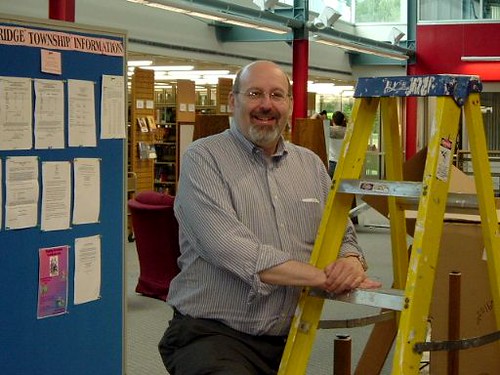
___________________Photo of Allan Keiman during construction of Senior Spaces

Mr. Kleiman has been active in the Aging Population Committee of the Reference and User Services Association (RUSA) section of the American Library Association for over 30 years. He authors two blogs - one about the Senior Spaces project and a personal blog - Library Services to Boomers & Older Adults. He is also looking for speakers for a program at next year's International Federation of Library Associations (IFLA) conference in Canada. The program title is "Serving Older Adults: 6 Countries - 6 Perspectives". He currently has found speakers representing Canada and the United States, but he is looking for speakers from other countries. Mr. Kleiman's contact information can be found on his Senior Spaces Blog. This program sounds very interesting. Some countries are anticipating an even higher rate of population aging than we will see in the United States. We could learn how librarians across the world are planning to meet the needs of their older adult population.

AddThis Social Bookmark Button

Saturday, June 02, 2007

Reader's Advisory for Older Adults

It is hard for librarians to find the time to keep up with all the library journals. I will be trying to find articles in these journals that relate to older adult services and report on them here. I found a great article from the Reference & User Services Quarterly by Alicia Ahlvers (2006). This article is literally packed with great information. Ahlvers starts by describing the characteristics of different segments of the older adult population. She talks about the G.I. generation (aged 85 and above), the Silent Generation (aged 65-84), and the Baby Boomers (aged 44-64).

She described the G.I. generation as gallant, hard working, and civic minded. She stated that they "are particularly fond of sentimental stories and novels with characters from their generation" (p. 306). She characterized the Silent Generation as reserved, hard working, and often stoic. According to Ahlvers, people in the Silent Generation tend to be receptive to books recommended by librarians. Ahlvers predicts that the Boomer generation will be assertive and will be more willing to use technology, such as an online library catalog.

Ahlvers used data from her library's homebound program to provide a list of the most popular materials ordered by these different generations. This is very useful, as is her discussion of how to conduct readers' advisory interviews for older adults.

I really liked Ahlver's recommendation that libraries be able to print the check out receipt in large print, so that older adults can read the due dates for their materials. That had not occurred to me before, and it makes a lot of sense.

Reference:
Ahlvers, Alicia. (2006). Older adults and readers' advisory. In Reference & User Services Quarterly, 45(4), p305(8). Retrieved June 02, 2007, from InfoTrac OneFile via Thomson Gale. (Your library may subscribe to this online database).

AddThis Social Bookmark Button

Thursday, May 24, 2007

How Volunteering Can Benefit Older Adults

Libraries are often interested in promoting volunteerism in older adults and encouraging their participation in library programing and intergenerational programs (see the excellent list of older adult services by Allan Kleiman). These libraries may also be looking for grants to fund such programs. It could be useful in grant applications to cite the Social Science research that shows the individual benefits from volunteering. I will be discussing some of the published papers about the benefits of volunteering in this post, so that it can be a handy starting point for librarians seeking this data.

Volunteering has many significant benefits for individuals, from an increased sense of well being, to increased social bonding and ego gratification (Cutler & Hendricks, 2000, p. s99). Individuals can also gain more social support (Cutler & Hendricks, 2000).

Morrow-Howell et al. (2003) studied older adults, which they defined as people 60 years of age and older. Morrow-Howell et al. (2003) found that the reported level of well-being increased as the number of hours people volunteered increased. This result was independent of the type of volunteer organization, the number of volunteer organizations to which the individual belonged, or the race or gender of the volunteer. As a result, this benefit is universal for older adults.

Greenfield and Marks (2004)
investigated the effects of formal volunteering on older adults' psychological well being. They found that volunteering had a positive effect on psychological well being and the it helped to offset the negative effects of no longer having a spouse, no longer having a job, or not having any living children. They conclude that volunteering helps older adults to "be cheerful and happy in later adulthood" (p. S265).

Musick, Herzog, and House (1999) actually found that volunteering had a protective effect against mortality for people aged 65 and older who volunteered 40 hours or less within the past year!

AddThis Social Bookmark Button

Age differences in volunteering?

It was previously thought that volunteerism gradually increased until it peaked at the age of about age 55 and then declined quickly (Cutler & Hendricks, 2000). However, previous studies did not compare different age groups while controlling for differences in sociodemographic attributes - such as the differences in mortality between men and women and the levels of education (Cutler & Hendricks, 2000). When these factors are controlled, it is evident that the older age groups are the most involved in volunteerism (Cutler & Hendricks, 2000).

Cutler and Hendrick predict that if people begin to live longer and educational levels increase, there will be even higher rates of older adult volunteering. This pool of available volunteers will also be increasing as the number of older adults in the United States increases (see a previous post). As a result, older adults are a great potential resource for libraries.

Libraries can encourage older adults to volunteer at the library and participate in intergenerational programs. In addition, libraries can act as bridges to connect older adults with local nonproft organizations and schools who are looking for volunteers. Information about local volunteer activities can be provided on signage at the library, promoted face-to-face by the staff, and included on the library website on a page set up for older adults.

AddThis Social Bookmark Button